Devyn Display Font for Handmade Creators
If you’ve ever spent hours tweaking a label, adjusting letter spacing on a wedding welcome sign, or second-guessing whether your printable wall art feels “special enough,” then you know how much weight the right font carries—not just aesthetically, but commercially. That’s why Devyn landed in my design toolkit and hasn’t left since. It’s not just another decorative display font; it’s a confident, expressive typeface built for makers who need beauty *and* function in equal measure.
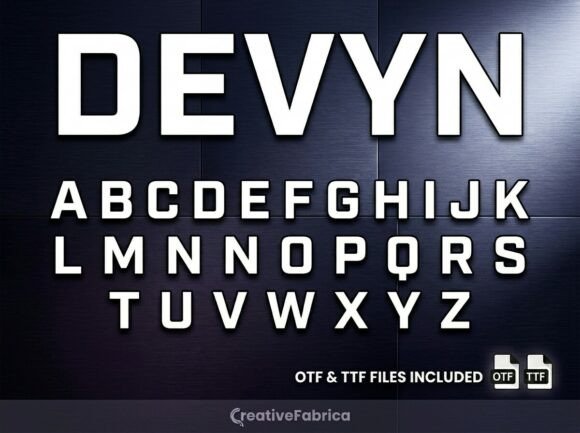
Visually, Devyn balances bold structure with artistic nuance—think clean outlines, subtle contrast between thick and thin strokes, and intentional imperfections that feel hand-drawn without sacrificing legibility. It’s not overly ornate, nor is it sterile. That sweet spot makes it ideal for physical products where customers see your work up close: a soy candle label held in hand, a sticker pressed onto a reusable water bottle, or a rustic wedding invitation slipped into an envelope. Its personality shines without shouting—and that’s rare in display fonts designed for real-world use.
I reach for Devyn most often when I need instant visual impact paired with quiet sophistication. For example, my best-selling lavender-scented candle line uses Devyn for the front label name—“Serene Fields”—set over a muted linen background. The font holds its shape beautifully at 24pt on a 2” x 3” sticker, cuts cleanly on my Cricut Maker (no jagged edges, even on inner curves), and reads clearly under boutique lighting. Same goes for seasonal product packaging: Devyn on holiday mugs, tote bags, and gift tags consistently draws compliments from buyers who notice “how elegant it looks—even on something simple.”
It’s equally strong in digital printables. I use Devyn for title blocks in planner undated pages, header text in SVG quote bundles for Silhouette users, and as the focal point in minimalist wall art PDFs. Because it’s designed as a display font—not meant for body text—it excels where attention needs to land first: names on baby shower invitations, shop name banners for Etsy storefronts, or “Open Daily” signage for small local boutiques. Just avoid long paragraphs; stick to short phrases, titles, and single words where Devyn can breathe and command space.
Readability matters most when scaling down. On 1” round stickers? Use Devyn at no smaller than 14pt, and skip intricate swashes for those sizes—opt instead for the standard uppercase or title-case glyphs. For laser-cut wooden tags or engraved acrylic signs, test spacing first: Devyn benefits from slightly increased letter-spacing (tracking +20–40 in design software) to prevent visual crowding. And yes—it previews cleanly in mockups, whether you’re showing off a branded mug on Placeit or building a Canva template for clients.
Font pairing is where Devyn truly sings. I almost always pair it with a warm, neutral sans serif—like Montserrat Light or Poppins Regular—for supporting text on labels, cards, or templates. That contrast gives hierarchy without competition. For wedding stationery, I’ll layer Devyn with a delicate script font (like “Lavanderia”) for names or dates—but only where space allows and readability stays high. Never force Devyn next to another bold display font; it’s the lead vocalist, not part of the chorus.
What’s included matters just as much as how it looks. Devyn comes with OpenType features like stylistic alternates and ligatures—small touches that elevate professionalism. I use the alternate “g” and “y” on boutique clothing tags for subtle distinction, and enable standard ligatures when setting “fi” or “fl” in invitation headers. It supports extended Latin characters, so names like “José,” “Müller,” or “Naïve” render cleanly across English, Spanish, French, and German printables—critical if you sell globally on Etsy or Gumroad.
File formats are practical, too: .OTF and .TTF files mean seamless compatibility with Cricut Design Space, Silhouette Studio, Adobe Creative Cloud, Canva (via upload), and even basic tools like Microsoft Word or Google Docs for quick mockups. No font manager required—just install and go.
One thing I always double-check before listing anything for sale: commercial licensing. Devyn is licensed for unlimited physical product use—so yes, you can stamp it on tea towels, embroider it onto aprons, or embed it in SVG files sold as digital downloads. You can also use it in client work (like designing a logo for a local bakery) and include it in editable Canva templates—as long as your end users aren’t redistributing the font file itself. That clarity saves me time, avoids legal gray areas, and lets me focus on creating—not qualifying.
Realistically, Devyn won’t replace your workhorse sans serif for ingredient lists or care instructions. But for moments that define your brand—your shop banner, your signature product name, the first word someone sees on your packaging—it builds recognition, warmth, and intentionality. Customers don’t buy fonts—they buy the feeling your products evoke. With Devyn, that feeling is grounded, artistic, and unmistakably yours.
Whether you’re printing 50 wedding menus or launching your first digital sticker pack, this display font earns its place in your creative workflow—not because it’s trendy, but because it works. Beautifully. Consistently. Commercially.